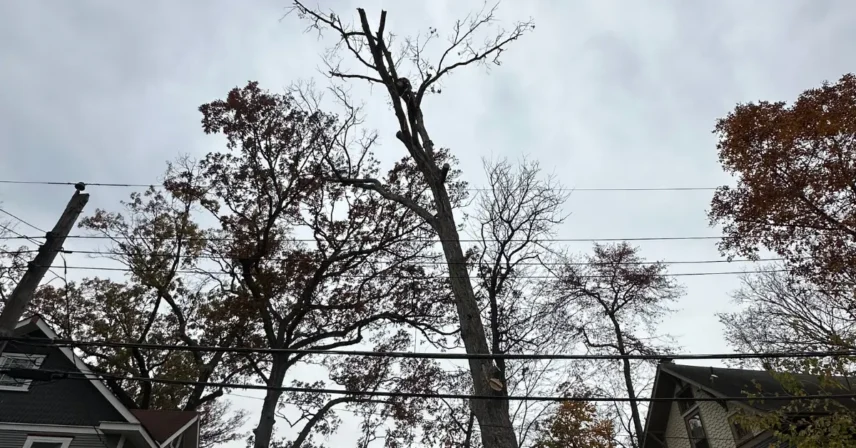
Trees growing too close to power lines create significant safety hazards, posing risks of electrocution, fires, and widespread power outages. Understanding when a tree becomes a danger and who is responsible for its management is crucial for homeowner safety and community reliability. Premier Tree & Landscaping specializes in safely assessing and addressing these complex situations, ensuring your property remains secure.
Key Takeaways
- Maintaining a 10-foot clearance from power lines is a federal safety standard for unqualified individuals.
- Homeowners are responsible for trees impacting the ‘service drop’ (pole-to-house line), while utilities manage main distribution lines.
- Professional arborists use specialized techniques like directional pruning to ensure safety and tree health.
- Attempting DIY tree trimming near power lines is extremely dangerous and can lead to severe injury or death.
- Identifying hazards like arcing, sagging lines, or direct contact is vital for prompt, safe intervention.
- Premier Tree & Landscaping offers expert assessment and safe, compliant tree services for power line conflicts.
What Constitutes a Safety Issue for Trees Near Power Lines?
A tree near power lines becomes a safety issue when any part of the tree, including branches, leaves, or the trunk, encroaches upon the minimum safe clearance zone around energized conductors. This proximity can lead to direct contact, arcing, or create a path for electricity to ground, posing severe risks.
The Critical 10-Foot Rule and OSHA Standards
The Occupational Safety and Health Administration (OSHA) mandates strict guidelines for working near power lines. For unqualified persons, which includes homeowners and general landscapers, a minimum approach distance of at least 10 feet from energized overhead lines is required. This ’10-foot rule’ is not just a suggestion; it is a critical safety standard to prevent electrocution. It is important to note that higher voltage transmission lines require even greater clearance distances, which is why only qualified utility line clearance professionals should work near them.
Recognizing Immediate Hazards
Beyond direct contact, several indicators signal a tree has become a hazard. Environmental factors such as storms, ice accumulation, and high wind events in Northern Virginia often accelerate tree-to-line conflicts, making regular monitoring essential:
- Branches Touching Lines: Any physical contact can cause immediate arcing or wear down insulation.
- Sagging or Downed Lines: Trees can pull lines down, especially during storms, making them highly dangerous.
- Visible Arcing or Sparks: This is an immediate emergency and indicates electricity is jumping from the line to the tree.
- Scorched or Burnt Branches: Signs of past electrical contact mean the hazard is ongoing or has recurred.
- Trees Growing Towards Lines: Even if not currently touching, rapid growth can quickly close the safety gap.
Who is Responsible: Homeowner vs. Utility Company?
The responsibility for tree trimming near power lines is not always straightforward; it depends on the type of power line involved. Understanding this distinction is crucial for proper maintenance and avoiding liability.
Utility Company Responsibility: Main Distribution Lines
Utility companies, like the local electricity provider, are responsible for maintaining clearance around the main distribution lines. These are the primary lines that run from pole to pole, delivering power to neighborhoods. Local utilities in Virginia follow strict vegetation management programs to maintain safe clearance around primary distribution lines. Federal regulations, such as the Federal Reliability Standard (FAC-003-4) enforced by the Federal Energy Regulatory Commission (FERC), mandate aggressive vegetation management to prevent widespread power outages caused by trees. Premier Tree & Landscaping often partners with utilities to perform this specialized work, adhering to strict safety protocols.
Homeowner Responsibility: The Service Drop
Homeowners are typically responsible for the service drop. This is the line that runs from the utility pole directly to your home’s meter. While the utility owns the line, the homeowner is usually accountable for maintaining trees and vegetation around it on their property. The University of Florida IFAS Extension clarifies this distinction, noting that if a tree on your property interferes with this service drop, it’s your responsibility to arrange for its trimming or removal by a qualified professional. Premier Tree & Landscaping provides expert services for these homeowner-responsible situations.
Responsibility Breakdown Table
This table clarifies the typical division of responsibility, though local ordinances and utility policies can vary slightly.
| Line Type | Description | Who is Responsible? | Typical Action |
| Main Distribution Line | Lines running pole-to-pole, serving multiple properties | Utility Company | Utility-contracted crews or Premier Tree & Landscaping |
| Service Drop | Line running from utility pole to individual home’s meter | Homeowner/Property Owner | Qualified arborist (e.g., Premier Tree & Landscaping) after utility de-energizes |
| Communication Lines | Cable, phone, internet lines (often below power lines) | Service Provider | Contact respective service provider for maintenance |
The Dangers of DIY Tree Trimming Near Power Lines
Attempting to trim trees near power lines without proper training, equipment, and safety precautions is incredibly dangerous. The risks are severe, ranging from electrocution to serious falls.
Electrocution Risk: The Invisible Threat
Electricity can travel through tree branches, even if they appear dry. A momentary contact can send a lethal current through a person or equipment. This is why OSHA 1910.269 specifically outlines safety requirements for line-clearance tree-trimming, emphasizing that only ‘qualified’ individuals with specialized training should perform such work. Premier Tree & Landscaping employs certified arborists who are trained in these rigorous safety standards.
Falls and Falling Debris
Even if you avoid electrocution, working at heights with heavy branches poses significant risks. Falls from ladders or trees, coupled with the potential for branches to spring back or fall unexpectedly, can cause severe injury. Professional tree services use specialized equipment like bucket trucks and advanced rigging techniques to manage these risks safely.
How Premier Tree & Landscaping Manages Power Line Conflicts
Professional tree services like Premier Tree & Landscaping utilize specific techniques and adhere to industry standards to manage trees near power lines safely and effectively. Our approach prioritizes both safety and tree health.
Expert Assessment and Utility Coordination
Before any work begins, our certified arborists conduct a thorough assessment of the tree, its proximity to power lines, and the overall site conditions. This includes identifying the type of line (main distribution vs. service drop), assessing tree health, and planning the safest approach. For safety and regulatory compliance, we do not perform work on energized primary distribution lines and coordinate with utilities when required, which is a critical step for homeowner-responsible service drops.
Specialized Pruning Techniques: Directional Pruning
Instead of ‘topping’ trees, which can harm tree health and promote weak, rapid regrowth towards lines, Premier Tree & Landscaping practices directional pruning. This technique involves selectively removing branches that grow towards power lines and encouraging growth away from them. The Virginia Tech Department of Forest Resources explains that directional pruning maintains the tree’s structural integrity and reduces the frequency of future conflicts. Common directional pruning methods include:
- V-Trimming: Creating a V-shape opening through the tree canopy to clear lines.
- L-Trimming: Removing branches from one side of the tree to clear a single line.
- Side Trimming: Pruning branches along the side of the line to maintain clearance.
Adherence to Industry Standards and Safety Protocols
Our team adheres strictly to ANSI A300 (Part 1) standards for tree care operations, which cover pruning practices, and OSHA 1910.269 for electrical safety. These standards ensure that all work is performed safely, efficiently, and in a manner that promotes the long-term health of the tree while maintaining required clearances. We utilize specialized insulated equipment and rigorous safety protocols to protect our crew and your property. Premier Tree & Landscaping’s commitment to these standards reflects our expertise and trustworthiness.
The Cost and Impact of Neglecting Tree-Line Conflicts
Proactive tree management around power lines is a wise investment. The costs of professional service are significantly lower than the potential expenses and dangers associated with power outages, property damage, or personal injury from electrical hazards.
Potential Financial and Safety Impacts
Neglecting tree overgrowth near power lines can lead to costly consequences:
- Power Outages: Trees are a leading cause of outages, disrupting homes and businesses.
- Property Damage: Falling branches can damage roofs, vehicles, and other structures.
- Fires: Electrical arcing can ignite dry foliage, leading to devastating fires.
- Personal Injury/Death: Direct contact with energized lines is often fatal.
- Increased Utility Bills: Faulty connections due to tree interference can sometimes increase energy consumption.
- Emergency Service Fees: Urgent, after-hours calls for dangerous tree situations can incur premium charges.
Investing in Professional Tree Care
While specific costs for tree services vary based on tree size, location, and complexity of the job, investing in professional trimming or removal from Premier Tree & Landscaping provides peace of mind. Our upfront estimates are transparent, detailing the scope of work and ensuring all safety measures are in place. This proactive approach safeguards your property and family, preventing potentially catastrophic events.
What You Should Do Next
If you have trees growing near power lines on your property, take immediate action to ensure safety. Do not attempt to handle the situation yourself.
- Assess the Situation: Determine if the tree is near a main distribution line or your service drop.
- Contact Your Utility: If it’s a main line or an immediate emergency (e.g., arcing, downed line), call your local utility company immediately. Do not approach the area.
- Contact Premier Tree & Landscaping: For trees near your service drop or if you’re unsure about responsibility, contact us for a professional assessment. We will advise on the safest and most compliant course of action.
- Schedule Regular Maintenance: Prevent future conflicts by scheduling routine tree care with certified arborists who understand utility clearance requirements. Premier Tree & Landscaping offers comprehensive tree health management.
Conclusion
Managing trees near power lines is a critical safety concern that demands professional expertise. Understanding the distinct responsibilities for main utility lines versus service drops empowers homeowners to act correctly. Premier Tree & Landscaping brings certified arborists and specialized equipment to safely address these complex situations, ensuring both property safety and reliable power. Do not attempt to prune trees near power lines yourself; the risks are too high.
Frequently Asked Questions
What is the ’10-foot rule’ for trees near power lines?
The general rule for unqualified individuals is to maintain a minimum approach distance of at least 10 feet from energized overhead lines. This is a critical safety standard enforced by OSHA to prevent severe injury or electrocution.
Who is responsible for trimming trees near my power lines?
Homeowners are typically responsible for trees interfering with the ‘service drop,’ which is the line running from the utility pole to their house. The utility company is responsible for maintaining clearance around the main distribution lines between poles.
How can I tell if a tree near a power line is a safety hazard?
Signs of a safety issue include branches touching or growing into power lines, arcing or sparking, sagging lines, or visible damage to lines after a storm. Always assume a downed line is energized and dangerous.
Can I trim trees near power lines myself?
No, it is extremely dangerous and illegal for unqualified individuals to trim trees near power lines. The risk of electrocution is severe. Always contact a qualified utility arborist or a professional tree service like Premier Tree & Landscaping.
Why do utility companies prune trees so aggressively?
Utilities prune aggressively to prevent power outages and meet federal reliability standards, such as those set by FERC. Vegetation interference is a leading cause of outages, making proactive trimming essential for grid stability.
What is directional pruning, and why is it used?
Directional pruning guides tree growth away from power lines without ‘topping’ the tree, which can cause rapid, weak regrowth. Techniques like V-trimming or L-trimming maintain tree health while ensuring line clearance.
What should I do if a tree branch is touching a power line?
Contact your local utility company first to report the issue. They will assess if it’s their responsibility. If it’s your service drop, contact a qualified and insured tree service like Premier Tree & Landscaping for a safe assessment and trimming.